"Reliability Isn't a Selling Point Any More – It's an Entry Requirement"
Alon Eshed on Aloplay’s busy five years
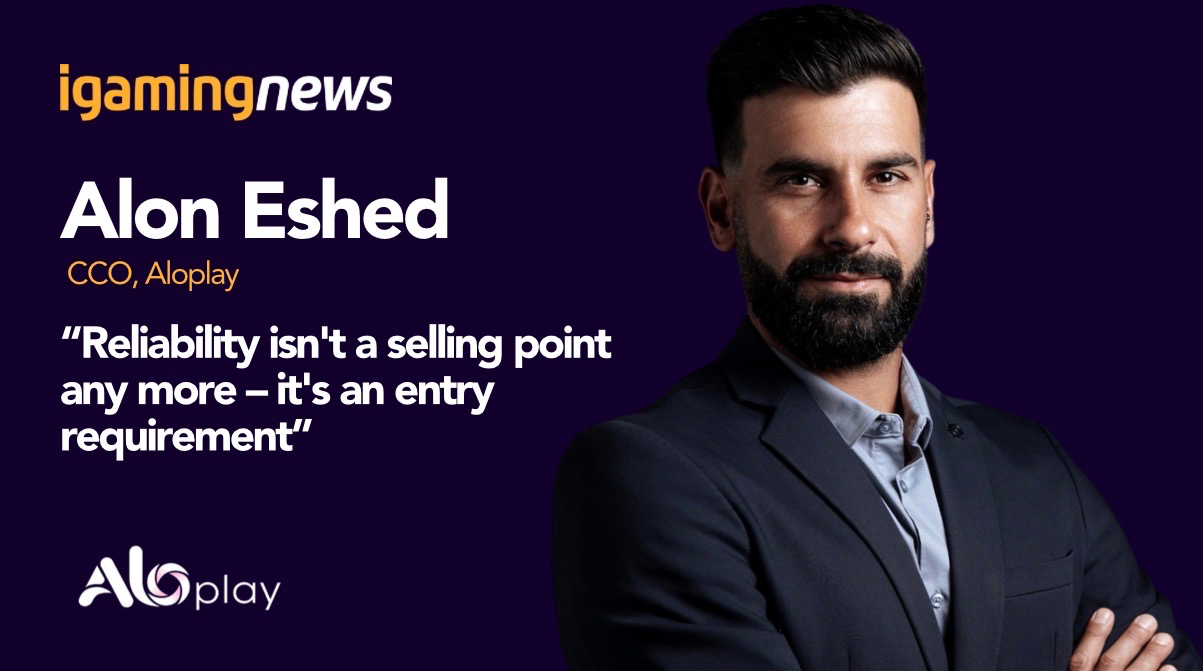
Alon Eshed joined Aloplay as Chief Commercial Officer after more than a decade selling into iGaming. We asked him about bringing a platform that spent five years proving itself to a wider audience, the recognition it's now winning, and why he's sceptical of most of what platform providers say about themselves.
You've joined a company that a lot of the market hasn't heard of. Is that a harder sell than you expected?
It's a different sell, for sure. With an established brand you spend the first meeting managing what someone already thinks about you, and some of that is wrong and quite hard to shift. Here I get a blank page, which I prefer, but it means every conversation has to earn its own credibility rather than borrowing any.
The uncomfortable part is that operators are cautious for good reason. Changing platform is one of the riskiest things they do. Being unknown isn't neutral – it costs you something, and you make that back by being specific rather than by being loud.
What did you find once you were inside that you couldn't see from outside?
How much work had gone into things that the outside doesn't see. There have been five hard, busy years of work on stability, on conversion and retention tooling, and on the internal machinery designed to support a growing portfolio of partners without any of them feeling the strain. None of that shows up in a press release.
Another thing I couldn't have known from outside was the speed. I raised things in my first weeks that at a larger company would have gone into a committee, and had decisions the same day.
Every platform provider in this industry calls itself flexible. Why should an operator believe you?
They shouldn't on the word alone, which might be a surprising answer! Flexibility dies the first time an operator asks for something awkward, and that's the only test that counts. That test comes in the third month, not the sales meeting – when someone wants a commercial structure changed or a requirement moved up the roadmap because it matters to their business even if it doesn't to ours.
What I'd tell an operator is to ask the provider for two examples of something they changed for a customer that wasn't on the roadmap, and then ask to speak to that customer.
Isn't "we're really a service business" what providers say when their technology isn't the differentiator?
Sometimes, yes. If the platform doesn't stay up or doesn't convert, no amount of account management rescues it, and anyone leading with service to cover a weak product will be quickly found out.
But reliability has stopped being a selling point – it's the entry requirement, and most serious providers clear it. The real differences show up beyond that line: how well a platform adapts, what it does to help an operator actually grow, and the people who make both happen. When an operator is choosing between three platforms that all technically work, that's the ground they're choosing on.
What's the first thing you changed after you arrived?
I put Sales, Marketing, Account Management and Technical Account Management under one single set of objectives. From the operator's side there's only one Aloplay, and when those functions are measured separately the partner ends up as the one who notices the gap, usually as a request that two people each assumed the other had picked up.
South Africa requires significant compliance investment. What makes it strategically important for Aloplay?
Because we could see where we'd add something, which isn't true everywhere. South Africa is an established and increasingly competitive market where well-supported operators still have a genuine opportunity to build a strong position there now rather than arriving once it's settled – that is exactly the kind of opportunity we want to be part of. Regulation, maturity and who's already established all matter, but the question we keep coming back to is whether an operator in that market is measurably better off with us than without us. If there's no answer, the size of the opportunity doesn't rescue it. We also won't take a licence speculatively and then go looking for a reason to use it. That's how providers end up carrying compliance costs against no revenue.
Operators have heard AI reporting promises from every vendor for two years now. What's actually different?
Fair scepticism. Most of what's been sold is a dashboard with a summary written on top of it, and operators can tell. The difference we're after is the move from passive reporting to active decision support. Reporting in this industry still largely tells you what happened last week, and by the time it reaches someone who can act on it the moment has gone. What we're building is meant to flag changes as they happen, show the commercial impact of each one, and point a team to where action is actually needed – affiliate performance and resource allocation as they move, not a month later. There should be something visible in the next few months, and I'd rather be judged on that than on the description.
What would make you say your first year here has worked?
If our existing partners have grown. New partnerships matter, of course, but the real test is what happens after the agreement is signed. If the operators already with us have launched additional brands, entered markets they couldn't reach before, and would take a call from someone considering us, that's our hard work paying off.