Ireland Sets Out Eight Game Categories Under Proposed Gambling Licensing Rules
Draft regulations would define the games eligible for licensing under the Gambling Regulation Act 2024, with operators required to disclose winning probabilities and key mechanics before play.
Listen to this article
British female voice
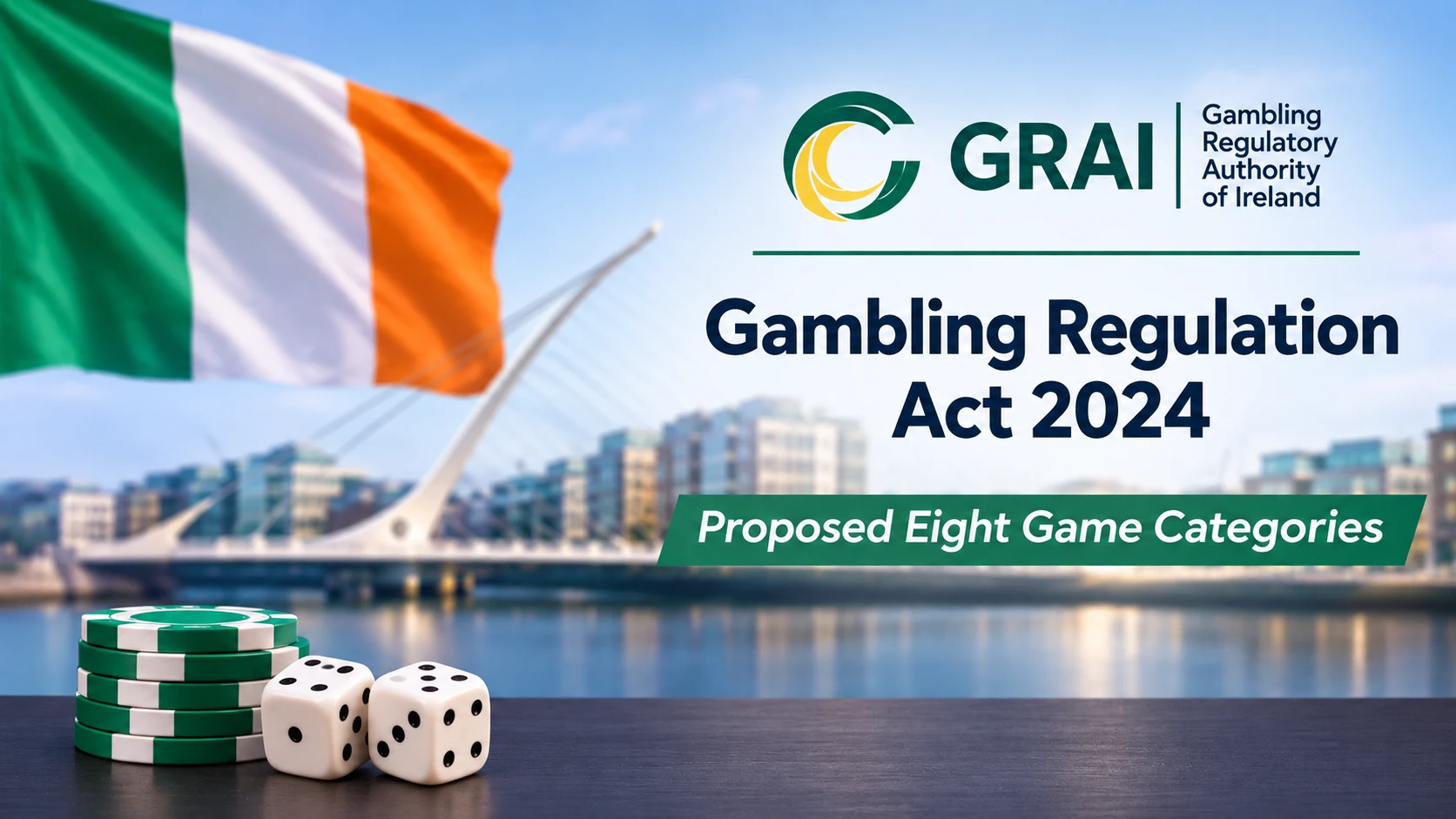
Ireland has proposed eight categories of games that could be licensed under its new gambling regulatory framework, with draft rules setting out requirements for randomness, winning probabilities and player information.
The proposed Gambling Regulation Act 2024 (Prescribed Games) Regulations 2026 would apply to business-to-consumer gambling and require operators to obtain specific authorisation for each game they offer. The categories cover card games, roulette and other wheel-based games, dice games, reel-and-symbol games, instant-win products, crash-style games, on-demand computer-simulated sports games and ball-drop games.
The Gambling Regulatory Authority of Ireland (GRAI) submitted the draft to the European Commission through its Technical Regulation Information System (TRIS) on 19 November 2026. The authority confirmed the notification on 24 November, with the standstill period scheduled to end on 22 February 2027 unless extended.
Under the proposed rules, all eight categories would need to provide players with information about the likelihood of winning before a game begins. This could include the house edge, return to player (RTP), winning odds and probabilities, as well as explanations of how skill or player decisions may influence outcomes.
Requirements For Individual Game Categories
The draft includes specific disclosure and technical requirements for different types of games. For crash-style products, where potential prizes change during play and players must avoid a termination event to secure a win, operators would need to explain multiplier mechanics, bonuses and manual or automatic cashout triggers.
All factors determining game outcomes would have to be governed by randomness, with the same requirement applying to computer-simulated sports games.
Ball-drop games would also be subject to randomness requirements covering the movement of balls or similar objects through obstacles, pins or pegs. Operators would need to disclose predetermined award locations and clearly show the ball's trajectory and final landing position. The proposal does not specifically authorise any product branded as Plinko.
For card games, operators would have to disclose the rules and deck information before play. Shuffling would need to be tamper-proof, sequential and random, while cards would also be required to have highly distinct visuals.
Instant-win products, including electronic scratch cards and push-button games, would need to explain available prizes, symbol mechanics and whether player choices affect results. Reel-based games would have to provide information on paylines, symbol restrictions, patterns, evaluation rules, active selections and winning combinations.
Dice games would require clear displays of winning faces, while simulated versions would also need to outline the available wagering options.
Consultation And Regulatory Framework
The proposed categories follow market research and a public consultation that attracted 123 submissions from operators, suppliers, consultants, industry organisations and members of the public. While respondents supported defining which games could be eligible for licensing, some raised concerns that rigid technical definitions might struggle to accommodate new products and technological developments.
The GRAI described the proposed framework as “lean and technologically neutral”, stating that it reflects games currently available in Ireland and the EU and should have minimal impact on cross-border trade.
The authority also referred to Economic and Social Research Institute studies published in 2023 and 2025. These identified higher levels of problem gambling than earlier research had suggested and highlighted the prevalence of gaming as a form of gambling. The GRAI linked the proposed licensing framework to its statutory responsibilities and public-interest protections.
The regulations are based on sections 9 and 86 of the Gambling Regulation Act 2024, including section 86(2). The GRAI cannot issue gaming licences under the new framework until the eligible game categories have been prescribed, although operators will still need to obtain licences and comply with the Act.
Registered as TRIS notification 2026/0662/IE, the draft does not yet have a commencement date and remains subject to sealing by the authority’s chairperson and chief executive.
Stay ahead of iGaming
Get the week's key stories, industry insight and exclusive interviews in your inbox.
One email a week. Unsubscribe any time. More about our newsletter